Process review

Two weeks to find out where the time actually goes.

Before anyone commits to a project, we look at one process with the people who run it and write down what it really costs and what would fix it. Fixed scope, fixed figure, and no obligation afterwards.

Book a 20-minute callAsk a question first
  • 2 weeks
  • 2 working sessions
  • 0 logins or data exports
  • 4 things you keep
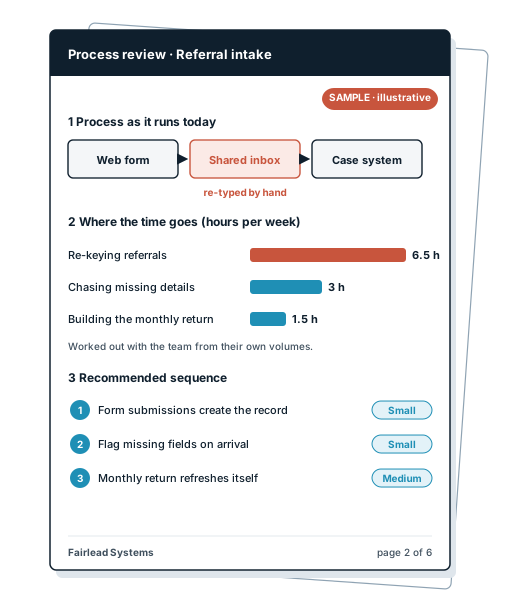
Sample page from a process review report, with illustrative figures: a process map, hours per week spent on three activities, and a recommended three-step sequence with effort for each.
What the report looks like. Sample page, illustrative figures.
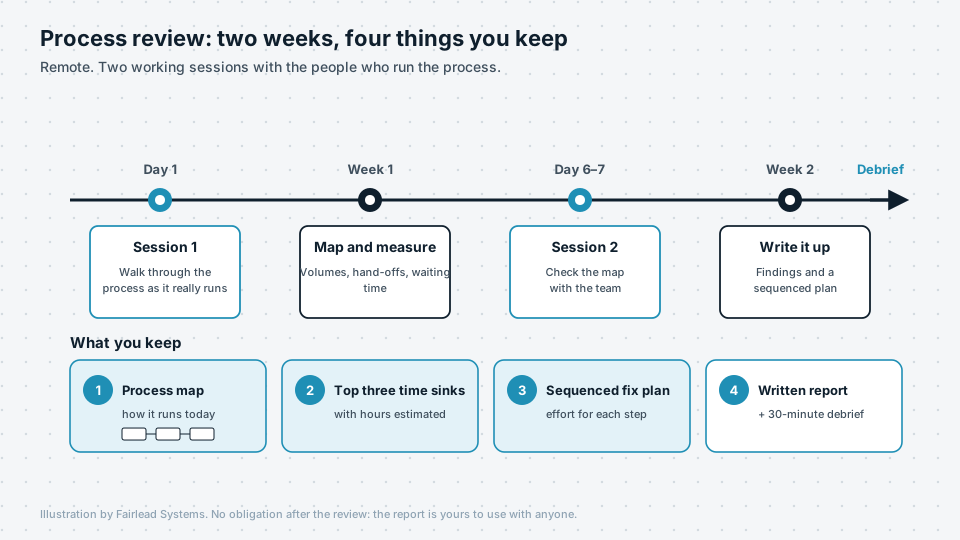
Timeline of a two-week process review: session one on day one, mapping and measuring in week one, session two to check the map, and a written report in week two, followed by a debrief. Four deliverables: a process map, the top three time sinks with hours estimated, a sequenced fix plan, and a written report with a 30-minute debrief.
What you get

Four things you keep, whatever you decide next.

  1. A map of the process as it runs today

    Who touches it, which systems it crosses, where it waits, and where information is typed more than once. Drawn from what people actually do, not from the procedure document.

  2. The three biggest time sinks

    Each with an estimate of the hours it costs, worked out with your team from your own volumes. We show the arithmetic so the figures can be checked.

  3. A sequenced plan to fix them

    What to change first, what each step involves and roughly how much effort it is. Where the answer is a settings change or "leave it alone", the plan says so.

  4. A written report and a 30-minute debrief

    A short document you can circulate internally or take to a board, a funder or a budget holder, and a call to walk through it with whoever needs to decide.

Who it is for

Useful when you know something is slow, but not exactly why.

Councils, NHS trusts, universities and colleges

Public sector

Monthly returns and board reports are assembled by copying figures from several spreadsheets.

Charities, community organisations and membership bodies

Charities and non-profits

Funder and trustee reports are rebuilt by hand every quarter, in a slightly different format each time.

Service firms, professional practices and operations-heavy SMEs

Small and medium-sized businesses

Client onboarding runs on email chains, attachments and a checklist someone keeps in their head.

It is not a security assessment, an IT audit or a procurement exercise. It looks at one process and how information moves through it. See the problems we are asked to fix most often, or estimate the cost with the re-keying calculator.

Questions

Before you book

What does it cost?
A fixed figure, agreed in writing before anything starts. It depends on how many teams and systems the process crosses, which we establish on a short first call. There are no day rates and no extras.
Are we committed to anything afterwards?
No. The report is yours, and you can act on it yourselves, with us, or with another supplier. Most of what it recommends can be built in tools you already have.
How much of our staff time does it take?
Two working sessions of 60 to 90 minutes with the people who run the process, a 30-minute debrief, and a few short follow-up questions by email in between.
Do you need access to our systems or personal data?
No. We look at the process together on a screen share. We do not need logins, exports or copies of personal data to produce the review.
Can a public body buy this directly?
It is deliberately small and fixed in scope, so it is usually well below the Procurement Act 2023 thresholds. Supplier questionnaires and procurement queries go to tenders@fairleadsystems.co.uk

Start with a 20-minute call

Tell us which process you have in mind. We will say whether a review is worth it, or whether the answer is simpler than that.