When the spreadsheet has become the system
A spreadsheet that started as a list and now runs part of the organisation, with dozens of tabs, fragile formulas and one person who understands it. We turn it into a structured system the whole team can use safely.
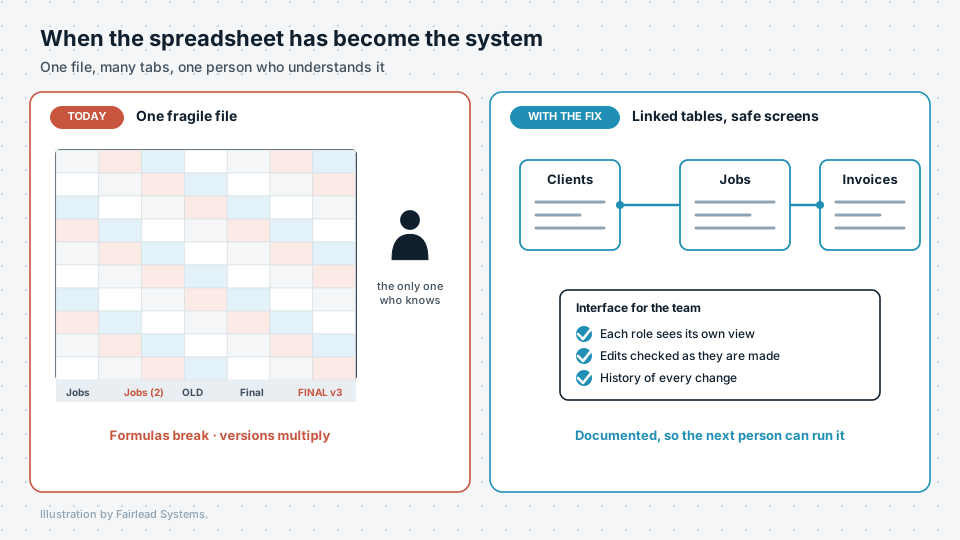
What it looks like today
The spreadsheet began as a simple list. Over the years it gained tabs, colour codes, lookups and copies with names like “Final” and “Final v3”. It now holds information the organisation depends on: clients, cases, volunteers, jobs, stock or bookings. Several people edit it, sometimes at the same time.
It mostly works, which is why it has never been replaced. But formulas break when a column moves, nobody is sure which copy is current, and when the person who built it is away, everything slows down. Sharing it safely, with each person seeing only what they should, is close to impossible.
What we build
We keep what works about the spreadsheet: it is familiar and flexible. We replace what does not. The information is split into linked tables, so a client, a job and an invoice are each recorded once and connected. Each role gets its own screen showing what they need and nothing else. Edits are checked as they are made, and every change is recorded.
This is usually an Airtable base with interfaces for the team. Where the volume or the reporting needs have outgrown the platform, a PostgreSQL database sits underneath it.
Migration is done carefully. The existing data is cleaned and moved in stages, and the spreadsheet stays available, read-only, until the team is confident in the new system.
What you get
- A map of what the spreadsheet actually does, including the parts only one person knew.
- The new system, built in your own account and tested with your team.
- Documentation written for the next person who has to run it.
Where it fits
Any organisation where a critical list has quietly become a critical system: case and referral tracking, volunteer and member management, job and stock records, bookings and rotas.
Is this costing you time?
Describe how the process runs today. We will tell you whether it is worth automating, and what it would involve, before anything is agreed.