Scheduled posting with a human veto
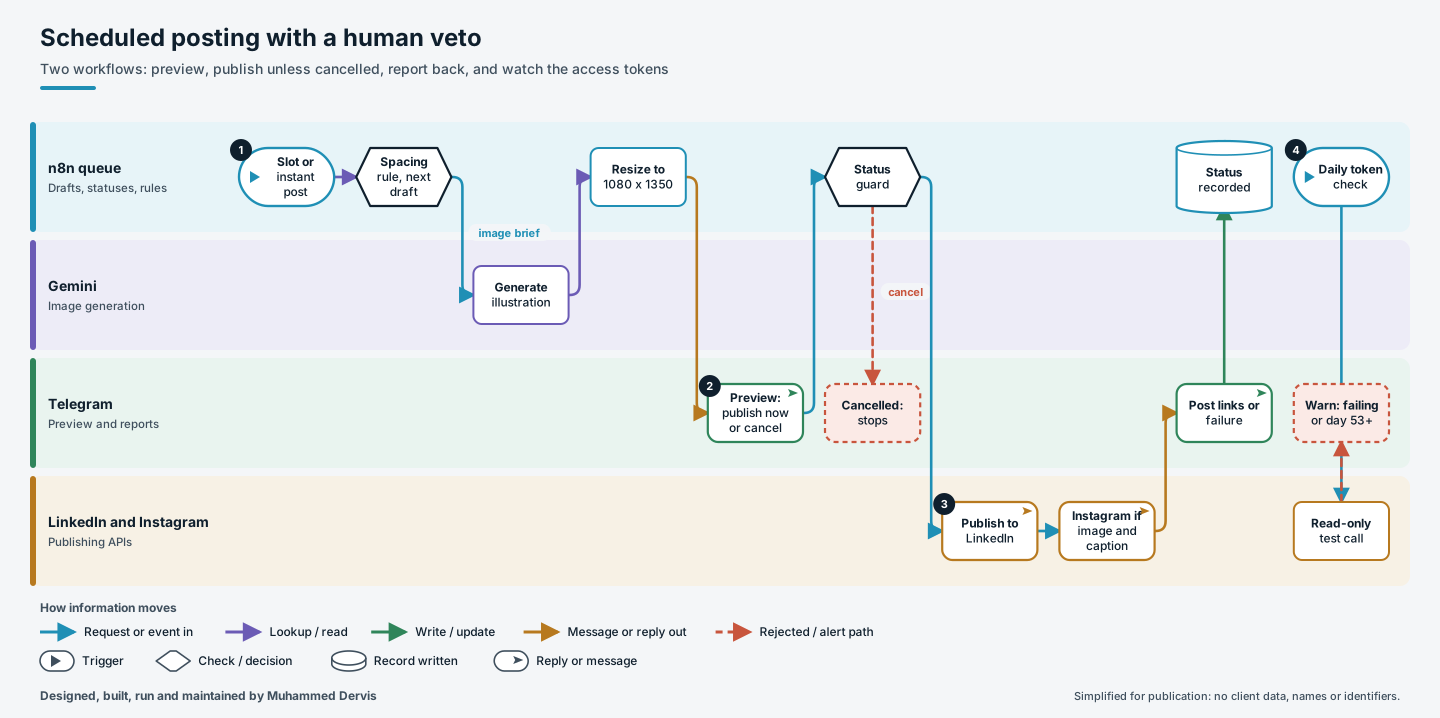
Posts are previewed on Telegram with a generated image and published on schedule unless cancelled, and a status guard means nothing goes out twice.
The problem
Posting regularly to two networks means writing captions, making an image at the right size, picking a time, publishing and then checking the post. Doing that by hand is repetitive. A fully automatic poster with no review step risks publishing something its author would have stopped. And social platform tokens expire quietly, which stops scheduled posts without any warning.
How it works
- Pick the next draft. Drafts sit in a queue inside n8n, each marked as scheduled, instant or Instagram-only. Two hours before a scheduled slot, or within minutes for an instant post, the next draft is picked, unless a post already went out in roughly the previous twenty hours.
- Preview with a veto. If the draft has an image brief, Gemini generates an illustration, which is resized and cropped to 1080 by 1350. A Telegram preview shows the text and image with two buttons: publish now, or cancel.
- Publish unless stopped. If nobody cancels, the post goes to LinkedIn at the slot time and, when it has an image and an Instagram caption, to Instagram as well. The resulting post links come back on Telegram, and any failure is reported and marked so it is never retried silently.
- Watch the access. Each morning a separate check makes a read-only call to both platforms and warns on Telegram if a call fails or a token is 53 days old, about a week before the usual expiry.
The engineering that matters
Each post moves through explicit statuses, and every change is a conditional update that refuses posts already published, cancelled or in progress. A double-tapped button or two overlapping triggers cannot publish the same post twice.
The preview buttons and the image address that Instagram fetches are protected by a random per-post token. The whole system is built from n8n’s own nodes and data tables, with no custom code, which keeps it readable for whoever maintains it next.
Have a process like this?
Tell us what it looks like today. We will say whether this approach would work for you.