Each collection agent sees only their own queue
Regional agents get a ready-to-use queue limited to their own countries, and every save drops blank values so it cannot wipe existing data.
The problem
Collection agents in different countries follow up new registrations and payment problems. Each agent should see only the trainees they are responsible for, with the payment methods, countries and local coordinators they need to choose from. Working in the shared database would have shown everyone’s records. And a naive “save” from a form would send every empty field and wipe values already held.
How it works
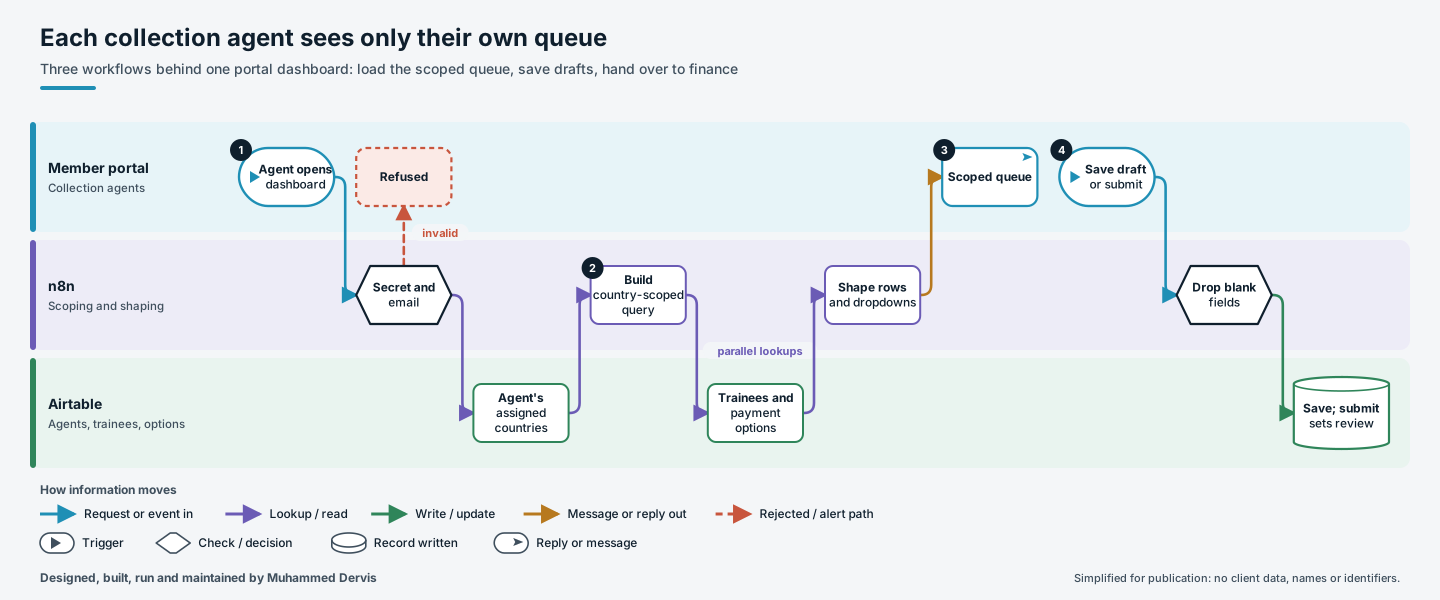
- Identify the agent. When an agent opens the dashboard, the portal calls the workflow with the agent’s email and a shared-secret header. Anything without the right secret or a valid email is refused.
- Build the scope. The agent’s profile is read and their assigned collection countries extracted. A database query is generated on the fly that returns only trainees in those countries whose status shows a new registration, temporary details or a payment problem.
- Shape the queue. In parallel, the active offline payment methods, the country list and the country coordinators are loaded. One shaping step resolves linked records into readable names and returns clean rows with the dropdown options the dashboard needs.
- Save safely. When the agent saves a draft or submits a trainee to finance, empty values are dropped except for a short list of payment fields that may be cleared on purpose. Submitting also sets the trainee’s status to “pending finance review” on the server, whatever the form sent.
The engineering that matters
Scoping happens on the server: the query is built from the agent’s assigned countries, not filtered in the browser.
The blank-value guard with an explicit list of clearable fields means a full-form submit cannot wipe values already held. Enforcing the status change on the server, rather than trusting the form, means every submission reliably lands in the finance queue.
Have a process like this?
Tell us what it looks like today. We will say whether this approach would work for you.