Context
The same organisation as the case study above, at an earlier stage. Teams spread across
several countries, running operations on Airtable. Nobody could afford a weekend where work
stopped, and nobody trusted a big-bang switch.
The problem
Airtable had run this organisation’s operations for years, and for most of that time it was
the right tool. This case study is about the point at which it stopped being — and how you
tell the difference between a base that needs restructuring and one that has genuinely
outgrown the platform.
Three signals had appeared together. Any one alone would have been a design problem. All
three at once is a different conversation.
The field was the only way to grow. One table had passed a hundred and thirty fields, a
third of them calculated and a dozen no longer used by anything. New requirements added
columns, because columns were the only tool available.
Relationships were being held together by parallel columns. Six separate columns pointed
at the same team table instead of one assignment relationship. Every change to the team
orphaned work.
Nothing enforced state. Five parallel status machines with no transition rules, so
combinations that should have been impossible existed in the data — records marked complete
whose design stage was still running.
Underneath all three, reference data was copied by hand between bases and then drifted,
permanently, because there was no way to keep them in step.
What we built
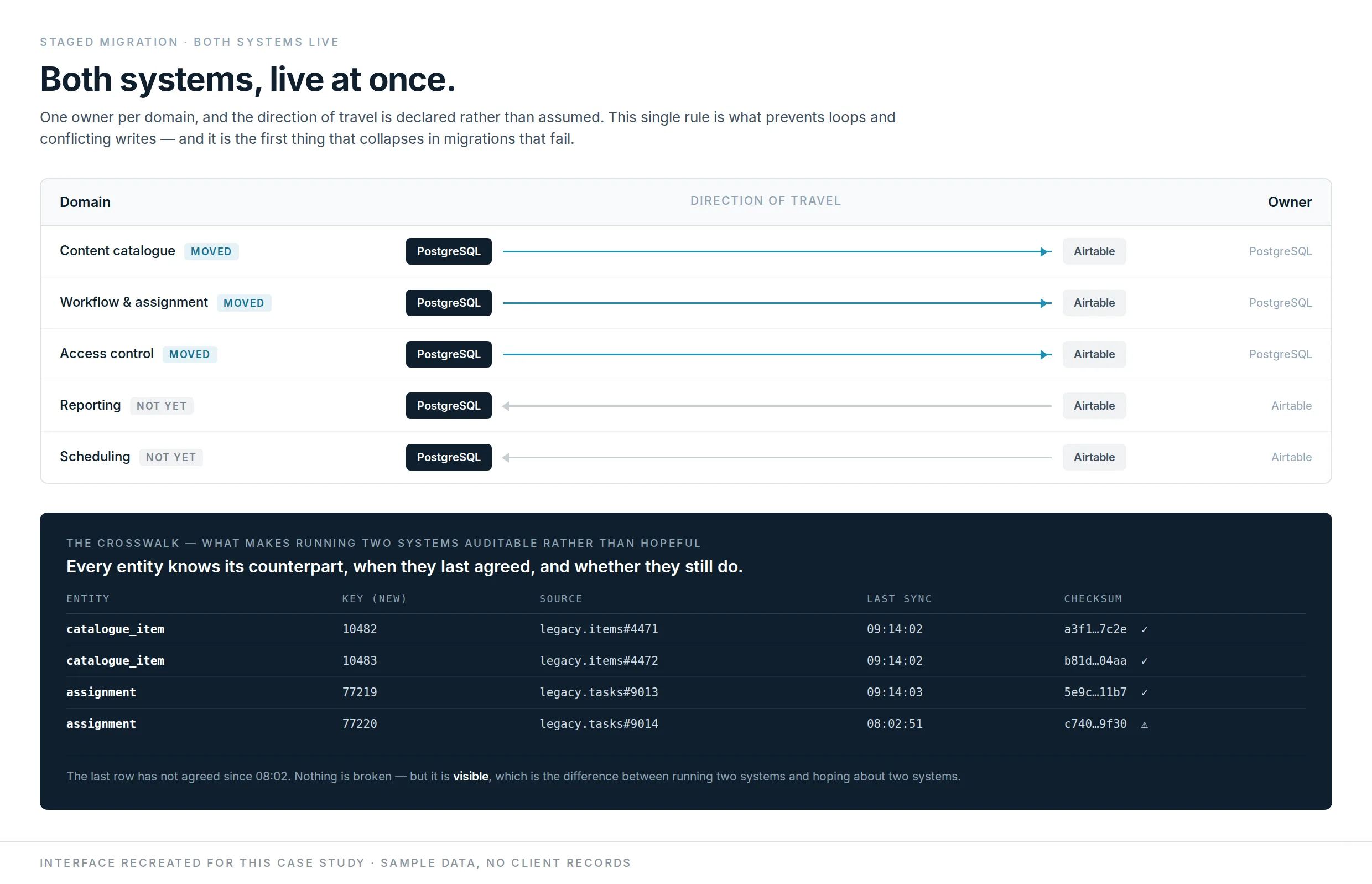
A staged migration. The new system grew alongside the old one, and the old one was never
switched off until it was already redundant.
- The old system became read-only, with a read-only token. Deletion from it stayed a
human decision, never something a script could do.
- A crosswalk table mapped every entity to its counterpart, with last-sync time and a
checksum. That table is what makes running two systems at once auditable rather than
hopeful.
- One owner per domain, and direction enforced. Once a domain moved, data flowed
new→old for that domain only; domains not yet moved flowed old→new. This single rule
prevents loops and conflicting writes, and it is the first thing that collapses in
migrations that fail.
- Key authority was settled before anything moved — the new system issues identifiers in
a reserved range that cannot collide with anything arriving from the old one.
- Net behaviour change of zero, as an acceptance criterion. Every new configuration
table was seeded to match existing behaviour exactly, and a generated column reproduced
the old display text verbatim. Existing filters, exports and reports kept working
throughout.
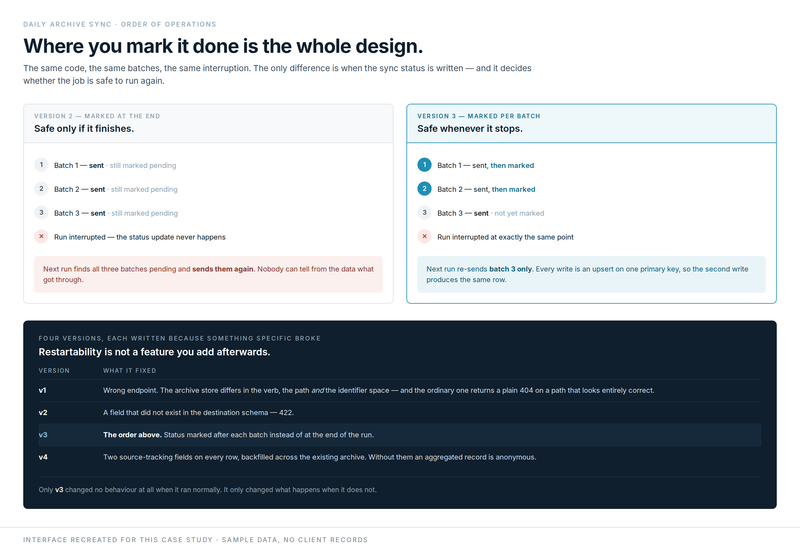
- Every change ran with ROLLBACK before it ran with COMMIT, and every write was an
upsert, so nothing depended on being run only once.
The result
The migration ran domain by domain with both systems live. The organisation chose when each
domain moved, and reporting never broke.
Most organisations that reach this point do not need to leave the platform. They need to
move the one layer that has outgrown it, and keep the rest. Knowing which of the two you are
looking at is the whole job.