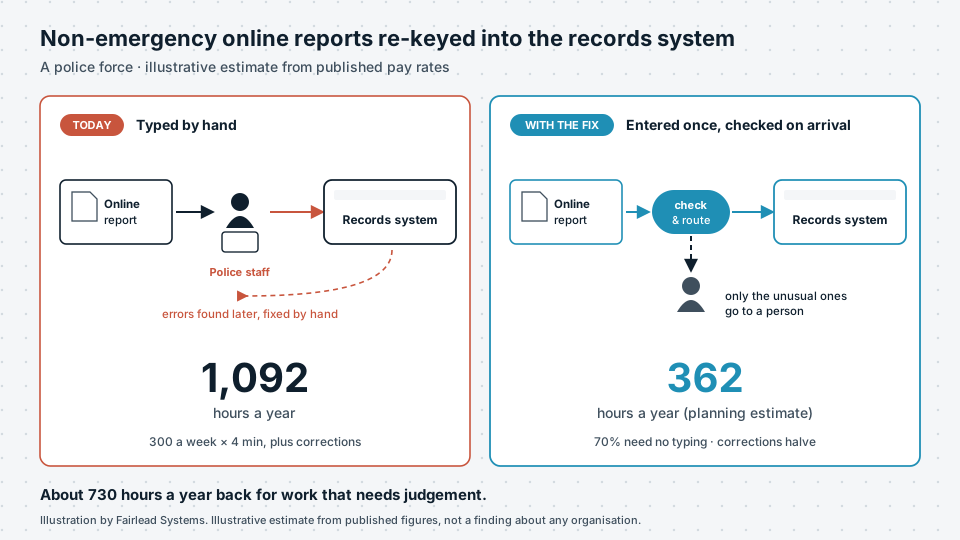
Non-emergency online reports re-keyed into the records system
1,093 hours a year£15,896 in staff pay
About 730 hours a year could be freed up.
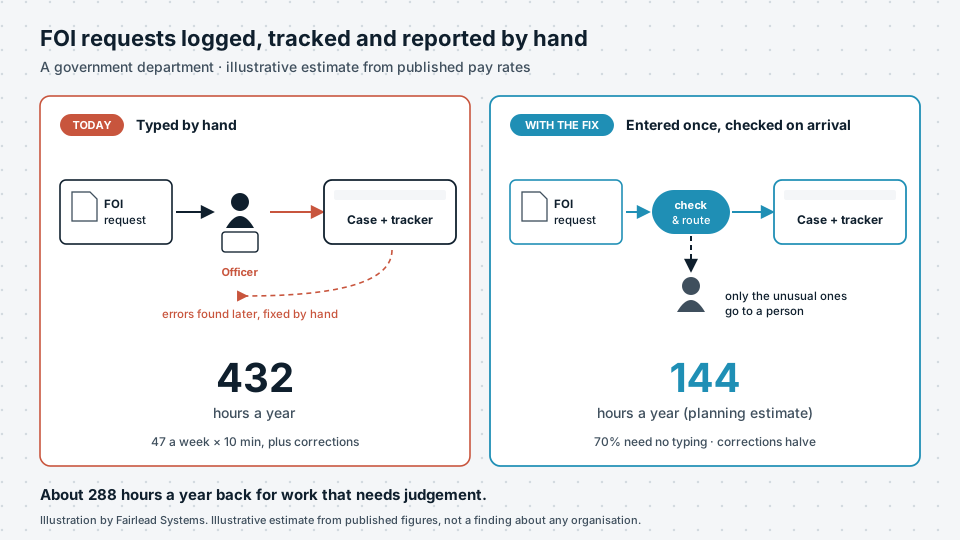
A typical monitored body received around 2,400 FOI requests in 2025. Each one is often logged and updated in more than one place.
Today
432 hours
£6,278
About 25% of one full-time working year.
With the fix (planning estimate)
144 hours
£2,093
Exceptions still handled by a person.
Freed up
288 hours
£4,186
Time back for the work that needs judgement.
For scale: The 39 central government bodies monitored received 94,526 FOI requests in 2025, about 2,400 each, or 47 a week.
A request arrives in a shared mailbox. An officer logs it in a tracker, opens a case, sends the acknowledgement, and later updates the status in the tracker, the case and the weekly statistics return. Each request is re-keyed several times across its life, and the statutory deadline is calculated by hand.
Log each request once, from the mailbox, into a single case record that calculates the deadline and drives the acknowledgement. Status changes update the tracker and the statistics automatically, so the weekly return is produced, not compiled. Officers spend their time on the response, which is the part that needs a person.
| Records re-keyed per week | 47 |
|---|---|
| Minutes per record | 10 |
| Records needing a correction | 10%, at 20 minutes each |
| Hourly cost | £14.52 |
| Working weeks a year | 46 |
| Typing | 360 hours |
| Corrections | 72 hours |
Hourly cost: Civil Service median salary in the administrative grades at 31 March 2026: £28,020, or £14.52 an hour at 37 hours a week. Pay only.
Volumes and minutes are typical planning figures for this kind of office, not measurements of any organisation. Replace them with your own.
"With the fix" assumes 70% of records reach the system without anyone typing them, the rest still take the full original time, and corrections halve because data is checked as it arrives. Those assumptions are deliberately cautious. A process review replaces them with measured figures before any price is agreed.
Illustrative estimate from published figures, not a finding about any organisation. Figures last checked on 3 October 2026.
1,093 hours a year£15,896 in staff pay
About 730 hours a year could be freed up.
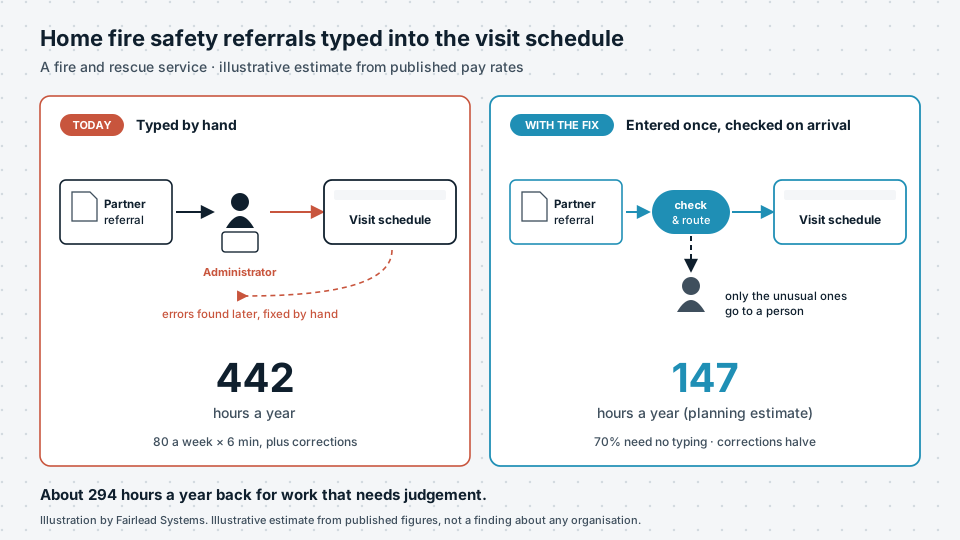
442 hours a year£6,545 in staff pay
About 294 hours a year could be freed up.
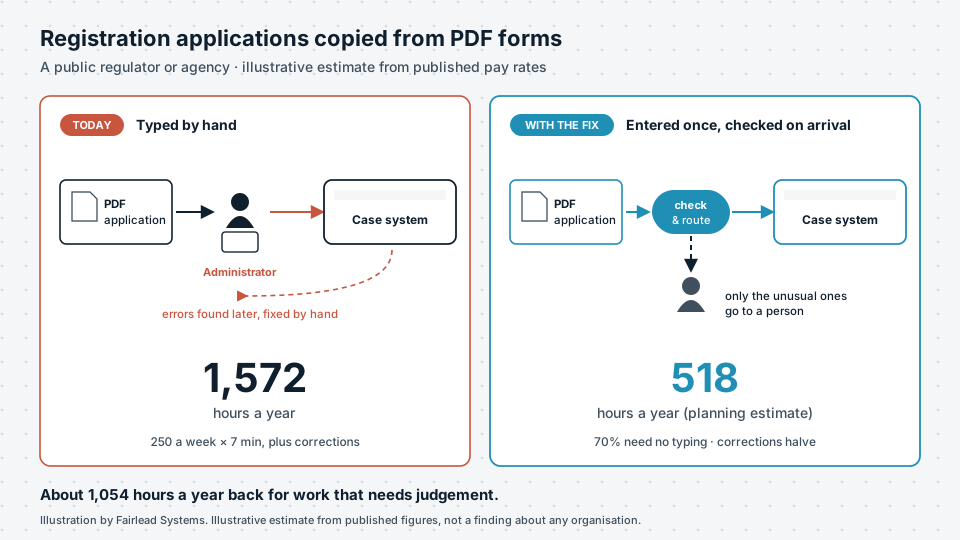
1,572 hours a year£22,821 in staff pay
About 1,054 hours a year could be freed up.
We would be glad to hear from you. Tell us how the work runs today: we will say plainly whether it is worth changing, how small the change can be, and what it would cost, before anyone commits to anything.