Stop re-keying the same information into two systems
When staff type the same record into one system and then again into another, every week costs hours and every copy is a chance for the two to disagree. We connect the systems so the record is entered once.
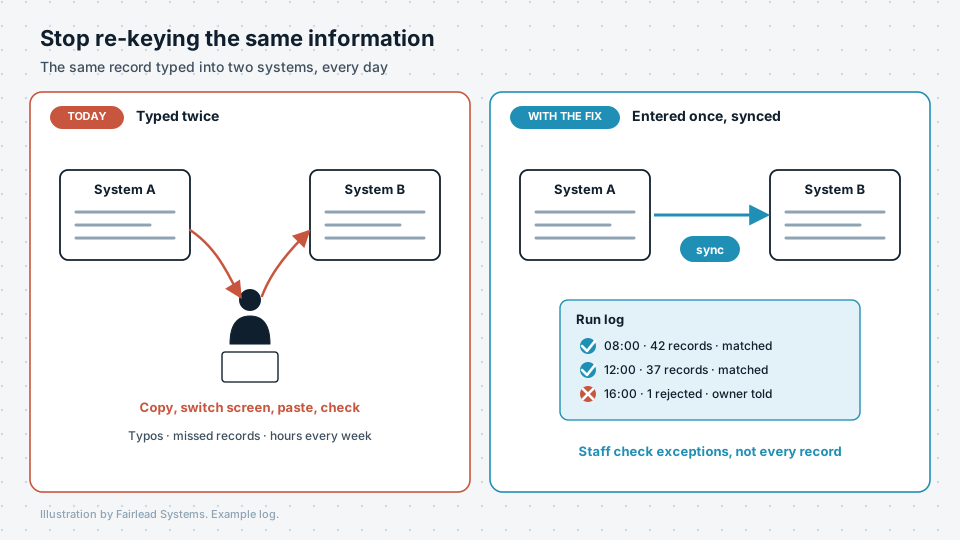
What it looks like today
A case is opened in one system and then set up again in the finance system. A new supporter is added to the CRM and then to the mailing tool. A job is booked in the scheduling tool and then retyped onto an invoice. Each step is small, so nobody treats it as a project. Together they make up a large part of somebody’s week.
Re-keying also creates a quieter problem. When the same information lives in two places, the two copies drift apart. Someone corrects an address in one system and not the other. A record is missed on a busy day. Eventually nobody is sure which version is right, and checking takes longer than the typing did.
What we build
We connect the two systems so that information entered in one appears in the other, in the right fields, without anyone copying it. Depending on what your systems allow, that is done with Make.com, n8n, Microsoft 365 tools or the systems’ own APIs. We prefer whichever your organisation can administer after we leave.
Every connection we build:
- checks each record before it is written, and holds back anything incomplete instead of guessing;
- keeps a run log, so you can see what moved, when, and what was rejected;
- tells a named person when something needs attention;
- can be run again safely, without creating duplicates.
The old process keeps running alongside until your team is satisfied the new one is right.
What you get
A short written map of the process as it runs today, the connection itself built in your own accounts, and plain-English documentation of what it does and what to check if something changes upstream.
Is it worth doing?
Not always. If the volume is low or the systems are about to be replaced, we will say so. The re-keying cost calculator gives a rough annual figure in a minute, using your own numbers.
Is this costing you time?
Describe how the process runs today. We will tell you whether it is worth automating, and what it would involve, before anything is agreed.