A guard that checks the other automations
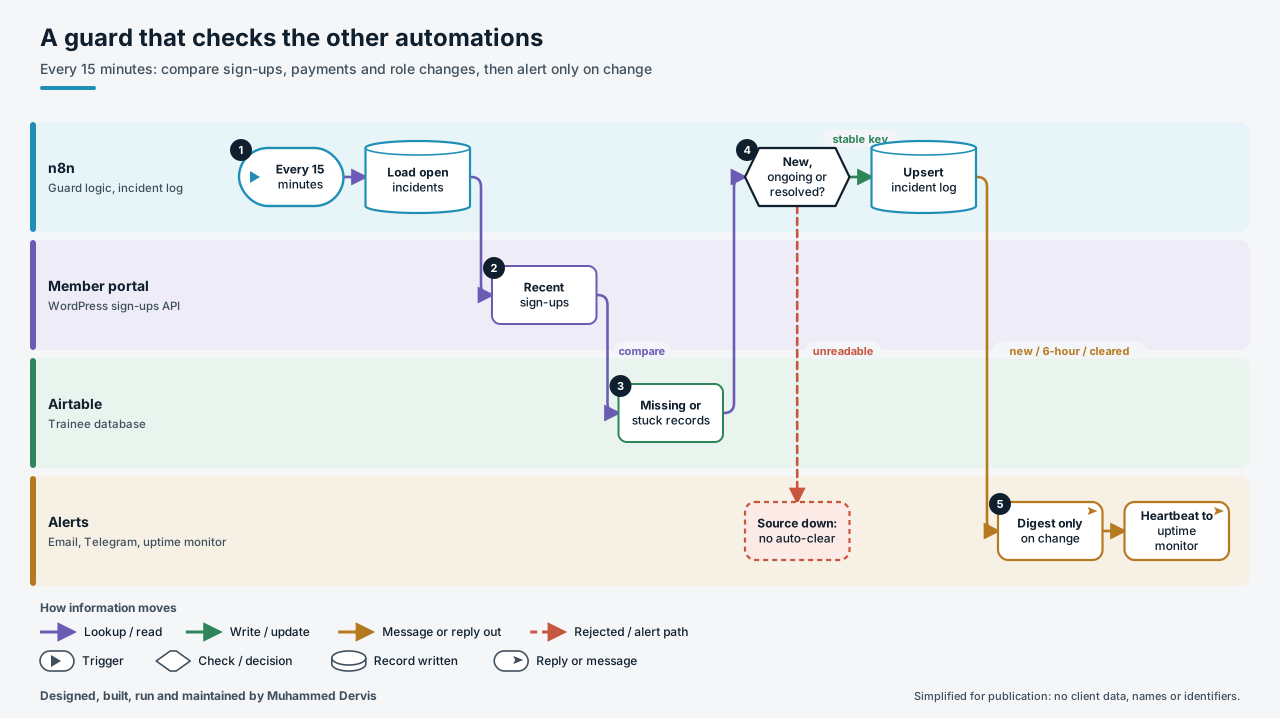
Every 15 minutes a guard checks that sign-ups, payments and access changes really happened, and speaks up only when something is new, still open after six hours, or resolved.
The problem
A trainee’s journey passes through several separate automations: the portal sign-up reaches the database, an approved payment opens the course, a completed assessment changes the trainee’s access. Each of those works on its own. When one fails quietly, a paying trainee is left without a record or without access, and the first anyone hears of it is a complaint.
How it works
- Start from what is already known. Every 15 minutes the guard loads the incidents it already has open.
- Ask the portal. It fetches recent sign-ups from the member portal’s API.
- Ask the database. It checks that each sign-up older than 20 minutes and younger than 72 hours exists as a trainee record, then looks for approved payments whose access change has not been recorded after 30 minutes, and for assessments whose role change failed or stalled.
- Classify. Each finding gets a stable incident key and is compared with what is open: new, ongoing, due a reminder, or resolved. The result is upserted into the incident log.
- Speak only when it matters. One digest goes out by email and Telegram when something new appears, when an open issue reaches six hours since its last alert, or when an issue clears. A heartbeat to an external uptime monitor shows the guard itself is still running.
The engineering that matters
Incidents are written on a deterministic key, so a problem seen in ten consecutive runs is one incident with a history, not ten alerts.
The most important rule is about what the guard does when it cannot see. If a data source cannot be read, the guard raises a source incident and deliberately does not auto-resolve that family of checks. An API outage can never be mistaken for “all clear”.
Time windows matter too. The 20-minute grace period lets the normal automations finish before the guard judges them, and the 72-hour ceiling keeps old, already-handled records out of the comparison.
Have a process like this?
Tell us what it looks like today. We will say whether this approach would work for you.