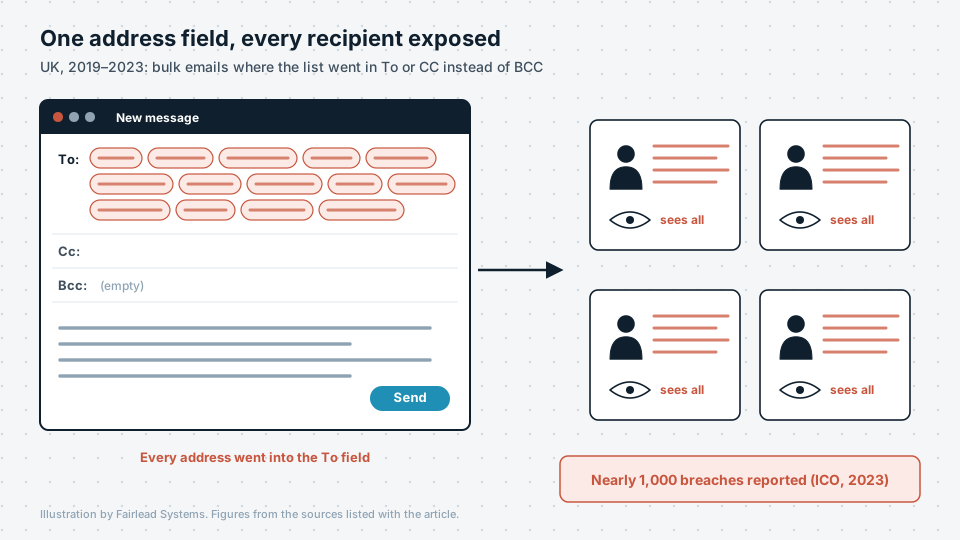
The ICO reported nearly 1,000 data breaches since 2019 caused by bulk emails that exposed recipients. Education, health and local government were the most affected sectors.
What happened
On 30 August 2023 the Information Commissioner’s Office reported nearly 1,000 data
breaches since 2019 caused by bulk emails where recipients could see each other’s
addresses, usually because an address list went into the “To” or “CC” field instead of
“BCC”. Education, health and local government were the three most affected sectors.
The ICO’s guidance was direct: blind carbon copy on its own is not enough to protect
people’s information. It recommended bulk email services, mail merge or secure transfer
instead.
The pattern
A task that is sensitive, repetitive and done by hand in a general-purpose tool will
eventually go wrong, however careful the people doing it. The cause is not carelessness.
It is a process where one wrong click is enough.
The ICO’s figures show the same mistake repeating across sectors and years. Training and reminders help, but they ask people to be perfect every time, under time pressure, in a tool that lets them type any address anywhere.
What a proportionate fix looks like
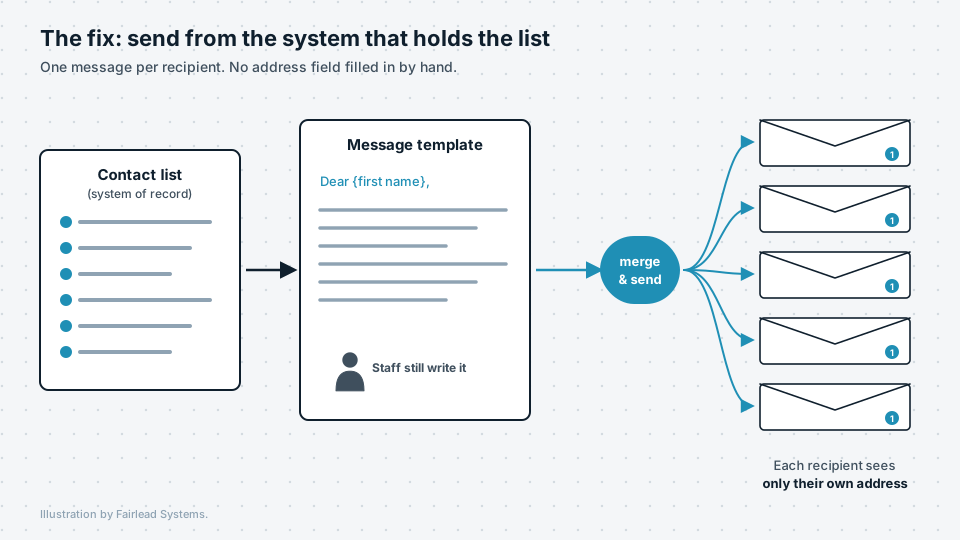
Sending from the system that holds the list removes the address field from the process.
Group messages should be sent from the system that already holds the list, as one message
per recipient, with no address field for anyone to fill in by hand. The people keep
writing the message; the risky step disappears.
Where a team regularly emails service users, parents, patients or residents as a group,
that is usually the first process worth looking at.
It also leaves a record of who was sent what and when, which helps if a complaint or a subject access request arrives later.
Questions worth asking
Which teams send the same kind of message to a group more than once a month?
Where does the list of recipients come from, and is it copied by hand into an email?
Would a mistake expose health, education, care or financial information?
Could the message be sent from the system that already holds the contact details?
Fairlead Systems was not involved in the events described here. The account above is drawn only from the sources listed, which were last checked on 1 October 2026. If you spot an error, write to us and we will correct it.
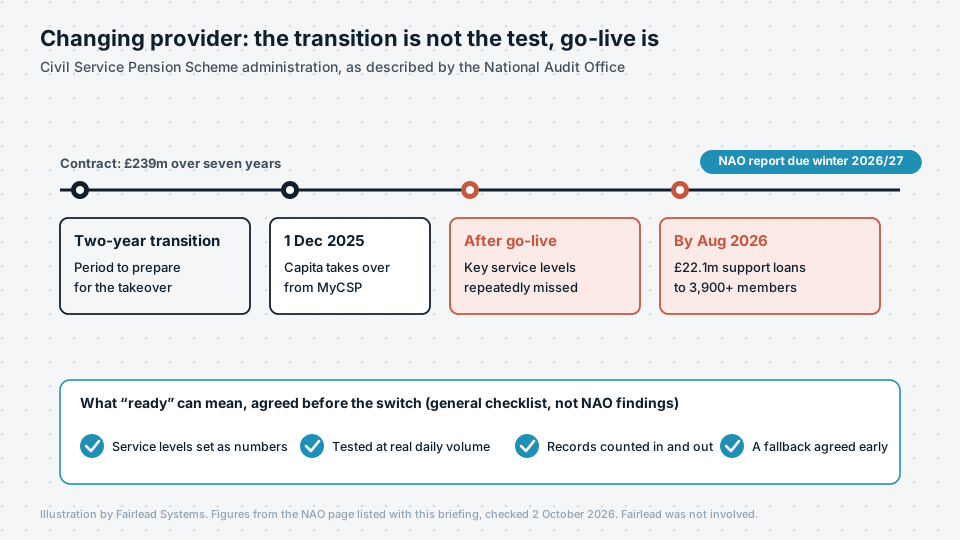
The National Audit Office is investigating the transfer of Civil Service Pension Scheme administration to Capita, after key service levels were repeatedly missed despite a two-year transition.
A long preparation period is not evidence that a service is ready on the day it goes live.
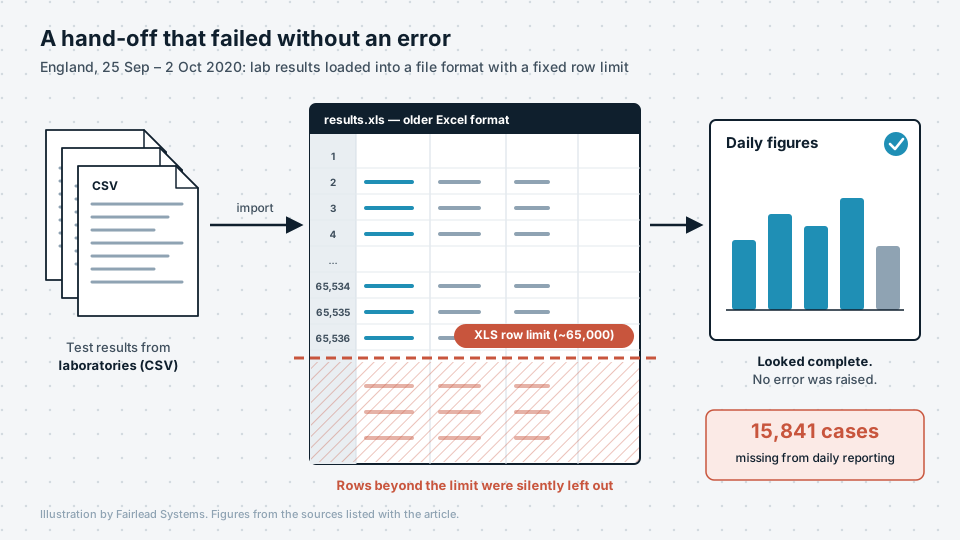
In 2020, 15,841 positive COVID-19 cases were left out of England's daily figures when a file format quietly cut off the data. The lesson is about hand-offs that fail without an error.
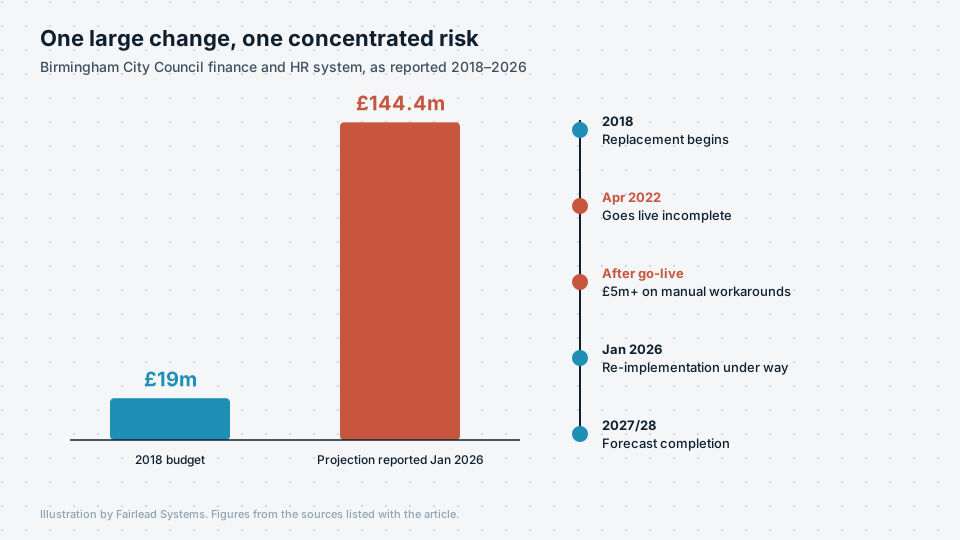
A council finance and HR system budgeted at £19m in 2018 was reported in January 2026 to be heading for £144.4m. For smaller organisations the transferable lesson is about the size and shape of change.
Large, heavily customised changes concentrate risk in one place.