Why the shape of a change matters as much as the system
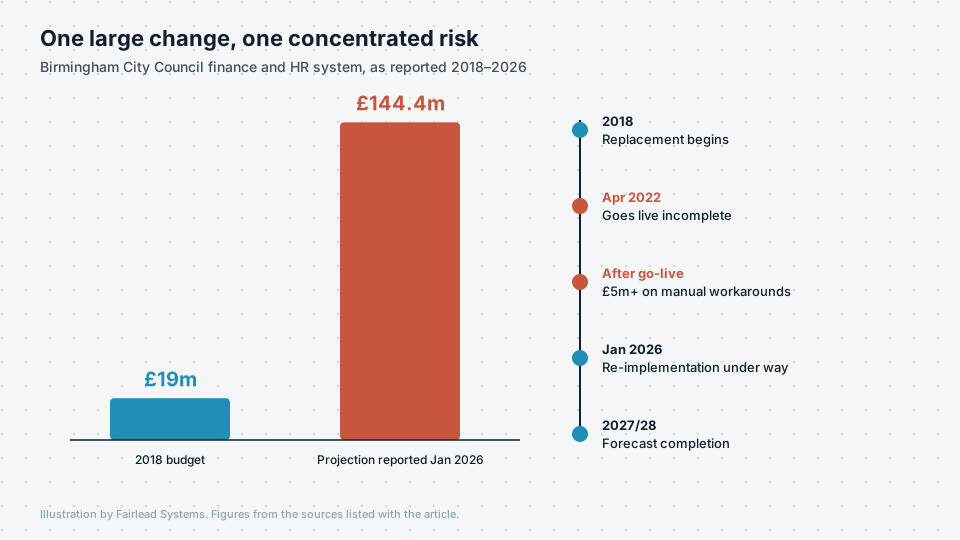
A council finance and HR system budgeted at £19m in 2018 was reported in January 2026 to be heading for £144.4m. For smaller organisations the transferable lesson is about the size and shape of change.
What happened
Birmingham City Council began replacing its finance and HR systems in 2018 with a budget
of £19 million. The new system went live incomplete in April 2022. Reported problems
included a banking reconciliation customisation that did not work, difficulty producing
auditable accounts, and more than £5 million spent on manual workarounds. As reported in
January 2026, the projected cost had reached £144.4 million, with a re-implementation under
way and completion forecast for 2027/28.
The pattern
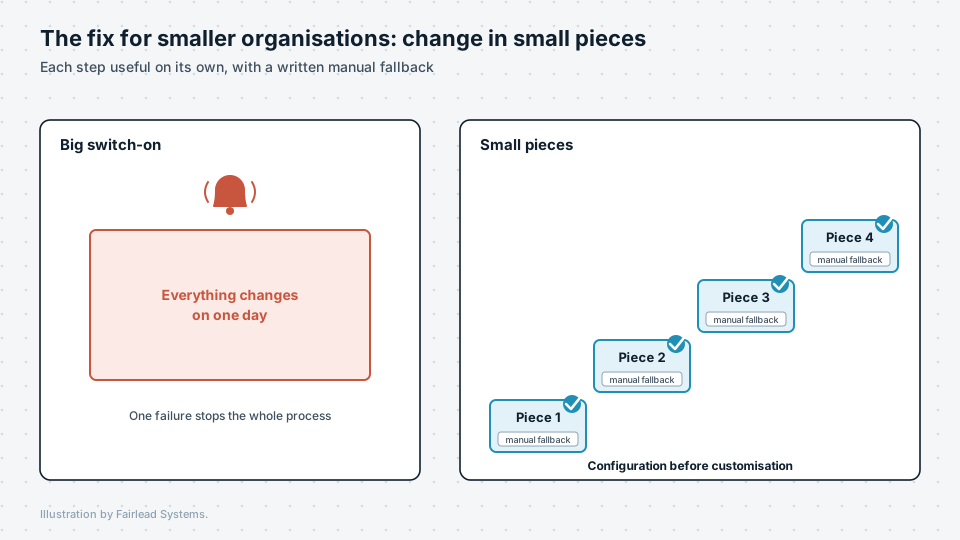
When a large system is heavily customised and switched on at once, risk is concentrated in
a single moment. If one critical function fails, the whole organisation falls back on
manual work while it is fixed.
The same shape appears at every scale. A small charity moving its donor records, or a firm replacing its job tracking, can switch everything over on one weekend and discover on Monday that one essential report no longer works.
What a proportionate fix looks like
The same change, shaped differently.
Fairlead does not implement enterprise resource planning systems, and this article is not
an argument that we could have done better. The lesson that transfers to smaller
organisations is about shape: change in small pieces that are each useful on their own,
prefer configuration to customisation, and make sure every automated step has a written
manual fallback.
In practice that means a sequence such as: connect the forms first, then the reporting, then the finance export, with each piece live and checked before the next begins. If one stalls, the others still deliver.
Questions worth asking
Can this change be split into pieces that are useful on their own?
Which parts need custom development, and could configuration do the job instead?
For each automated step, what is the manual fallback, and is it written down?
What would we do on day one if the most important function did not work?
Fairlead Systems was not involved in the events described here. The account above is drawn only from the sources listed, which were last checked on 1 October 2026. If you spot an error, write to us and we will correct it.
Insights
More from the public record
From the public record · London 2020 · Ireland 2021
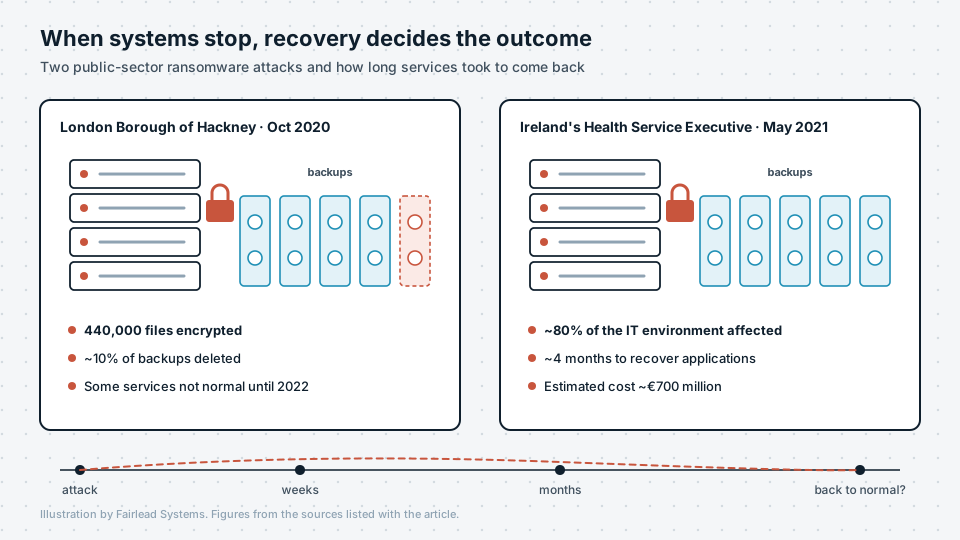
Ransomware attacks on Hackney Council in 2020 and Ireland's health service in 2021 disrupted services for months. The question that matters is whether a service can keep running, and whether recovery has ever been tested.
Recovery plans that have never been rehearsed.
Read the article →
From the public record · UK central government · 2022
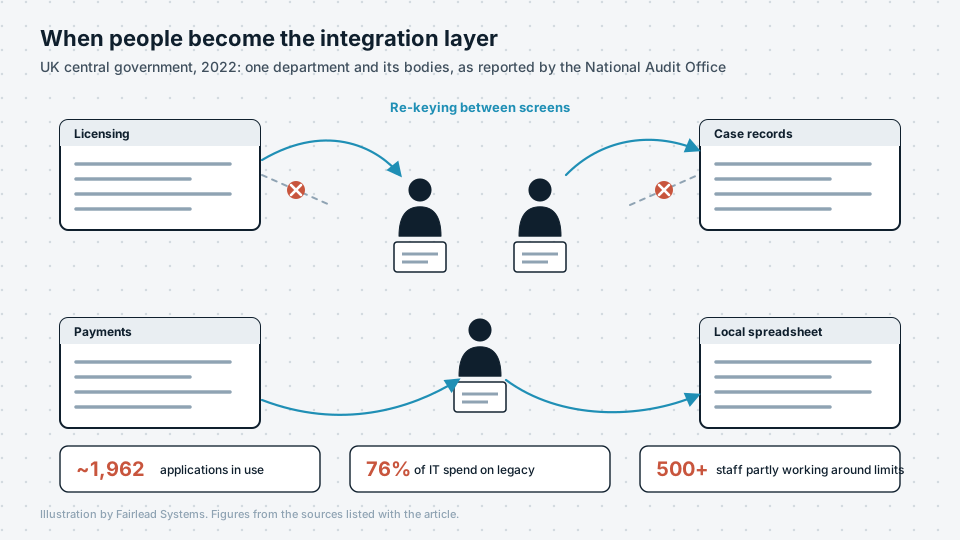
A 2022 National Audit Office report found a government department running around 1,962 applications, with legacy systems taking 76% of IT spend and more than 500 staff working around their limits.
Replacement is slow, so people re-key data between systems that cannot talk to each other.
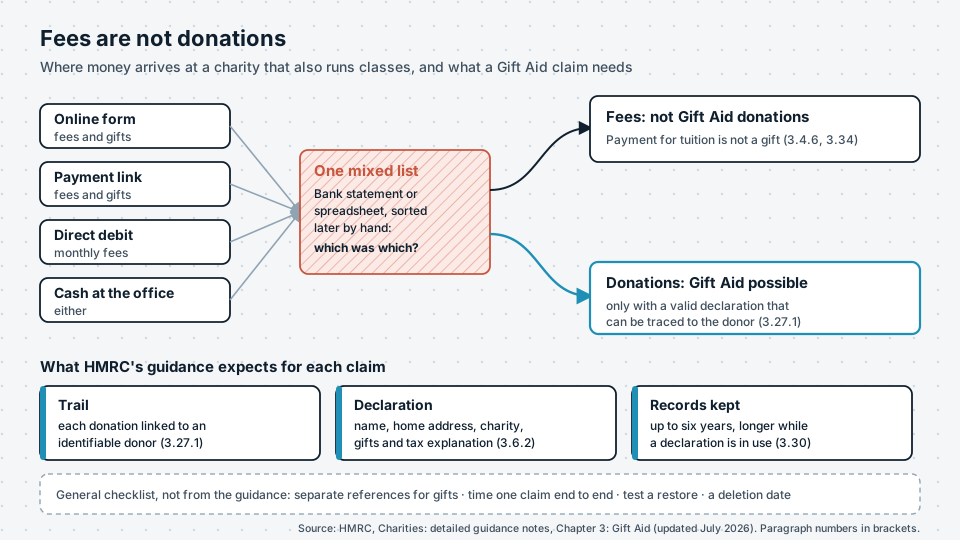
HMRC's Gift Aid guidance says payments for tuition are not gifts, and that every claim needs an audit trail from each donation to a valid declaration. Charities that take fees and donations through the same channels have to keep the two apart.
When fees and donations share one record, the Gift Aid claim inherits every mix-up.