What was published
HMRC’s detailed guidance on Gift Aid, Chapter 3 of its guidance notes for charities (last
updated in July 2026), sets out what counts as a donation and what a charity has to keep to
support a claim. Three points matter for any charity that also charges for what it teaches.
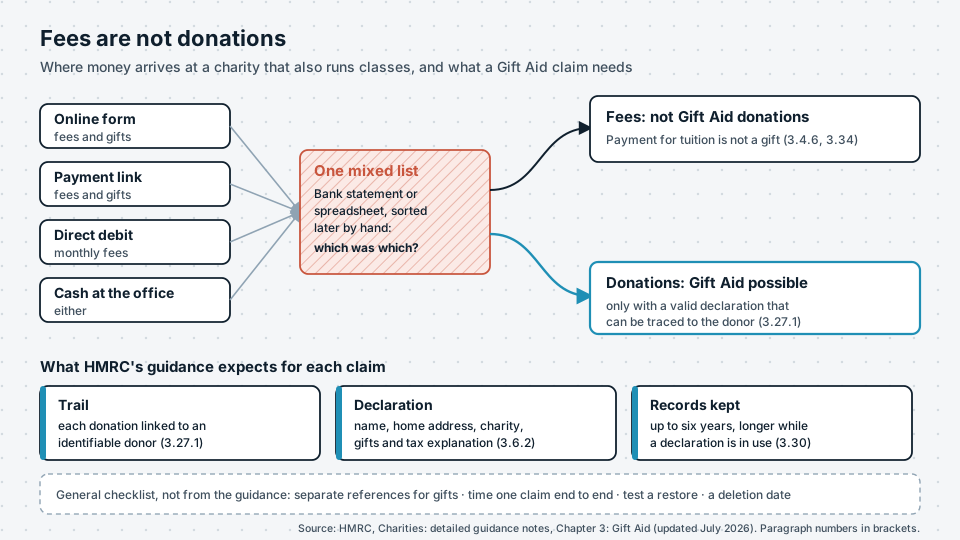
- A fee is not a gift. Payments in return for services, rights or goods are not gifts,
and school fees paid for a particular pupil are one of the guidance’s examples (3.4.6). In
its words, “the payment of fees to a charity is not a gift to charity” (3.34).
- Every claim needs a trail. A charity must keep records that link each donation to an
identifiable donor who has made a valid declaration (3.27.1). The declaration has to
give the donor’s name and home address, name the charity, cover the gifts and explain the
tax position to the donor (3.6.2). Copying details from a form into a database is not, on
its own, a record that the donor made the declaration (3.7.2).
- Records are kept for years. Depending on how the charity is set up, records are kept
for up to six years after the period they relate to, and for as long as an ongoing
declaration is in use (3.30). Where records are not good enough, the declaration can be
treated as invalid and the tax repaid, with interest and possibly penalties (3.8.1).
Why it matters for schools, madrasahs and academies
Many charities that teach also fundraise: weekend and evening madrasahs, supplementary
schools, online academies, mosque education departments. Families pay a monthly or termly
fee, and the same families give to an appeal or a building fund, often through the same
website, the same payment provider and sometimes the same direct debit.
When a fee and a gift arrive through one channel, someone has to decide later which was
which, usually from a bank statement. That decision becomes the basis of the claim. A fee
claimed by mistake is tax to repay. A gift without a declaration that can be traced is a
claim the charity cannot support.
What to check
- List every place money arrives (online form, payment link, direct debit, cash at the
office) and say, for each, whether it takes fees, donations or both.
- Give donations their own reference, one that never appears on a fee.
- Pick one recent claim and time how long it takes to go from a single donation to the
declaration the donor actually gave.
- Know where declarations are stored, who can change them, and whether you have ever
restored them from a backup.
- Decide what happens to a declaration when a family stops paying fees but keeps giving.
- Put a date in the diary to delete records once the retention period has passed.
This note summarises HMRC’s published guidance. Fairlead Systems has no connection with it,
and it is not tax advice: check the full guidance, or ask an adviser, before changing how
you claim.
Fairlead Systems was not involved in the events described here. The account above is drawn only from the sources listed, which were last checked on 17 October 2026. If you spot an error, write to us and we will correct it.