What was published
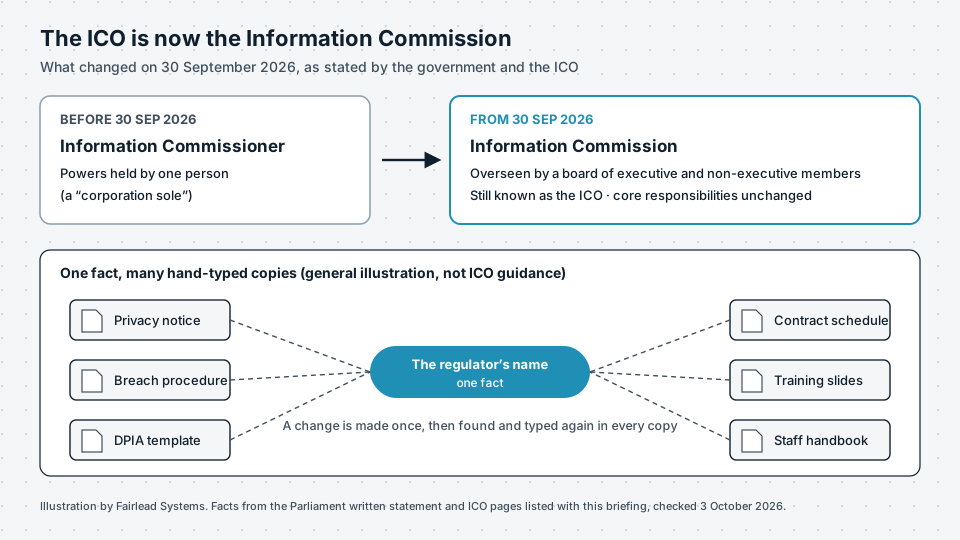
In a written statement to Parliament on 14 September 2026, the government confirmed that the
Information Commissioner’s Office would become the Information Commission on 30 September,
under the Data (Use and Access) Act 2025. The change is to how the regulator is governed.
Powers that were held by one person, the Information Commissioner, now sit with a body
overseen by a board of executive and non-executive members.
On 30 September the ICO said the transition does not change the Commission’s core
responsibilities. The legal entity is the Information Commission. The organisation is the
Information Commission’s Office, and it is still referred to as the ICO. It has also opened
a new head office in Manchester.
Why it matters beyond this case
Nothing in these announcements asks organisations to act by a deadline. The change is still
a useful test. Privacy notices, breach procedures, DPIA templates, contract schedules,
training slides and staff handbooks all name the regulator. In most organisations each copy
was typed by hand, so any change has to be found and made in every one of them. A name is a
small fact. Contact details and procedures change too, and the work of finding every copy
is the same.
A quick check
- Search your shared drives for “Information Commissioner”. Count the documents that come
back, and note who owns each one.
- Mark which of them are templates that new documents are copied from.
- Keep facts that change, such as names, addresses and contact routes, in one place that
other documents point to.
- Where wording does need to change, a document’s next scheduled review is a natural point
to do it.
Fairlead Systems was not involved in the events described here. The account above is drawn only from the sources listed, which were last checked on 3 October 2026. If you spot an error, write to us and we will correct it.